The Informal Economy Upgrade
Hear how everyday businesses can move from survival mode to stronger systems, better tools, and lasting growth.
Open full transcript
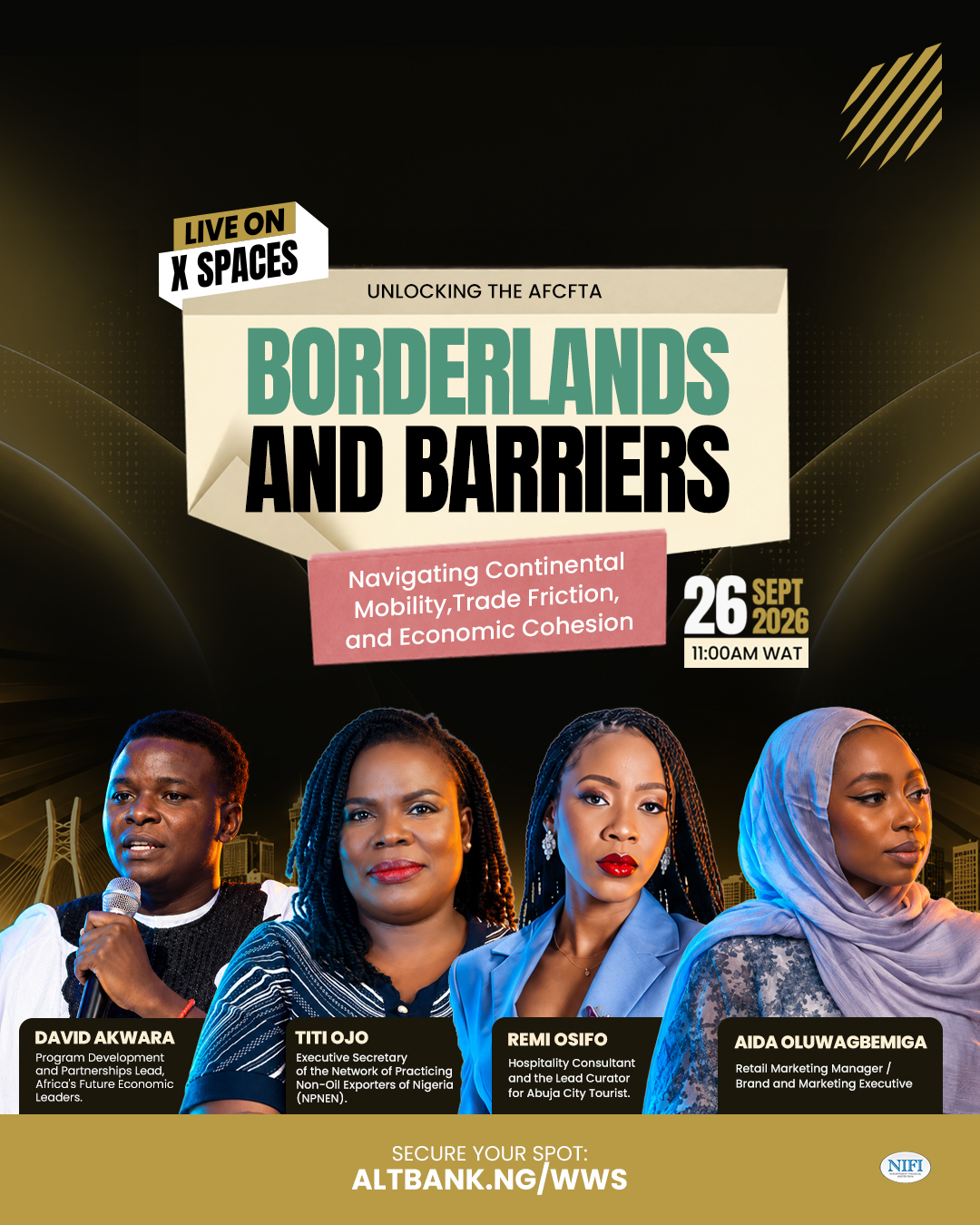
Good morning everyone. Hello, good morning everyone. Welcome to another nine journey to the X-based by Altbank. Today we're joined by four exciting guests, Uyo Yoyo Idiosio, the Chief ICT and Innovation Express at the African Development Bank, as well as Osato Adupai AKA EDK, a media personality and
host at JustVan. Also joined by Tiwal Luwa Omar Pert, the essay on Digital Economy, an economic business developer and a key to state innovation ecosystem builder, as well as our very own Jokotola, Arie Breshola, the head of Product Marketing at Alt Bank. And we're here to discuss the informal economy upgrade. What happens when Nigeria's informal
sector becomes fully digitized, who wins and who loses. Thank you all for joining us and it's so good to have you all on our panel today ladies and gentlemen. I believe that EDK and Omar Pia haven't joined us but we have Uyayo and Jokotohla here so like I can see Omar Pia. So you can And also, hello, so that the audience can hear you.
How are you doing? Thank you. Hi, and welcome to the call. How are you?
Jo, can you hear us? Yes, I can hear you. Please, can you can hear me. I'm right, Jo, can we can hear you?
So we're waiting for EDK now. So while we wait for EDK to join us, we're going to start with one very simple question, which we used to set up the turn every time.
So now before we get into economics in your own words, you would individually tell us what a non-junity of actually means to you. So, Oyo, you please go first.
Good question, I guess. So, to me, I think a non-junity of is one that is calculated. Like, we know when to up, we know when to blend in. We know when to put our heads low to strategize our next move.
and we know when it's time to pivot calculated. That will be my word. I really like that. I like that we're calculated to our lower.
Good morning everyone. Good morning either. I'll say an adjective is one that is resilient. It one that is that adapts to situations
and also is survival. It's so valuable, I'm pretty, though. Thank you. All right, thank you, Joko.
Hi, Joko. Yeah. I'll say in a negative is someone that we saw school. Someone that is able to think of alternatives on the spot
and make things work regardless of obstacles. All right, well, interesting. It's also interesting that at old Bancreux so I think that's for me that just means being an old Bancreux personnel.
So EDK so hasn't joined so it is going to proceed. So now what's one very Nigerian hostel or business model that you think technology has completely transformed in the last five years? Now this question is to everyone, we're going to have a joke. For me, I think it's in the way we do payments and collections prior to five years ago with a very cash
reliant economy. Well, with the likes of purest is the way we make payments, the way the collect payments has changed tremendously. Even at the alternative bank, we're feeling heavily in that space with our killed terminals and beyond just the terminal, we've used it as an enabler for commerce as well. So I would say what has changed is in the way businesses,
elect payments and make payments as well. All right. Thank you for that. So I'm going to show the question to you as well. Will you hear? I brought a group with what Jaka said. It's the way it's it's even beyond just the
collection and payments at the banking level. It's the way SMEs have built layers on this and they brought in things like financing when you're solar system so you can peel it as you go for solar or the way you can now even just finance logistics on the back of a working payment and collection
system. It's very impressive to be that's privator from just a regular financial layer to now an enabler of businesses with our commerce, with that energy, the new HBN agent and there are lots more there were things. So yeah, the FinTech space here.
All right. So to all lower, in the government space, do you agree or do you have a contrary opinion? I totally agree. I also want to achieve in that technology has helped creatives in terms of content creation.
I just hope that they become more visible. And I think all agree now that they're earning more. So yeah. All right.
So the creative in the house, Ozzato, EDK, you're going to wrap this up for us. Do you agree or do you have a different take? But just since you joined us a bit later,
I'm going to repeat the question. What are you doing? What are you doing? All right.
So what's one very Nigerian hustle of business model that you think technology has completely transformed in the last five years? Yeah, actually, I think a lot of the panelists
have covered everything. When you look at how easy it needs to get cash on the label with POS operator, for example, it's transformed, it's transformed everything.
We can lots of bang networks, tend to fail due to a variety of reasons and it seems a lot easier for us to do that. And also with the creative economy, we've seen just a massive explosion in
like previous weekend just mentioned the ability to create faster and creating the whole new career path, a whole new career path, a lot of young night chance especially so that would be it. All right then. So the next question is also to all of you but we're going to
start with to our lower as well with the time around. So what's the most impressive small-line journey business you've seen recently that already operates like a global company. Yeah, for me, I'll just look at here. Currently there is a local enterprise in equity. It process the process in traditional young people, quality of the local here.
And the standard community process in my terms, and the beginning to adopt digital inventory tools, professional branding and also leveraging our social commerce platforms. And now they're taking all that online and shipping parts from Nigeria exporting
from Nigeria to the UK to the US. Of course, there are Fiskov food printers there. What? Global currently. Yeah. So that's why.
the in. Yeah, I didn't actually know that they did that in the QT. I actually I know that you're doing all year, but this is the first time we're in a weekly. All right. So, over to you, EDK. Sorry, how did this be a little bit of a glitch? And I'm sorry for joining it by the way, I've been having that on issues. Could you repeat the question? That's
really fine. So it's what's the most impressive small mind around business you've seen recently that already operates like a global economy. Is child considered small? I mean, I think it's probably well.
Yeah, I mean, they're big. I think they're a great example to look at how they've really and they've become so blind because I'm not sure who could have cost on myself. They've made my life incredibly easy and I'm sure a lot of the 9-year-olds, especially, starting how they started and how they've grown so fast.
and challenging for space with international players like Bluewind and so on. So there'd be my pick, my kinful of all the programs that they're making. Yeah, Dracotala. I'll say generally I'm really impressed by the BC industry in Nigeria.
More specifically I'll talk about a brand called Beauty by AD. I'm just not a really small, making small batches of makeup conditions on that for the African skin. And if you look at the trajectory she's been on, she's really been impressive. If you look at her packaging, the way she communicates and she even shifts globally as well. So
I'm really interested in beauty industry putting us on the map when it comes to skin care, makeup and everything that has to do with the African woman. Thank you Joe and oh yeah, please help us wrap up this question. After my needs one again, not so young, but neither they old.
It's the way they've taken the problem of electricity and created financial options appears. You go like a loan option where people can have so in that as installed in their house and paying very little up-run and then advertising the app.
over a month. It solves a real issue for many managers. 100K now you can have a power in your house. That is getting changed for me. Hi, thank you all for your answers. So now to the technocrats in the house, the more technical people in the house,
which is we owe you and to our lower. What's one thing, the managers are already doing digitally that proves we adapt faster than people think. So we are being the lady ladies first. Okay, nice.
I think one thing that is impressive for me is the way everyone just adopted AI into their businesses. And as you know, like if all of you use Claude, we know ourselves when you see those documents coming and you see those PowerPoint coming or you see those Claude generated images.
You're like, right, it was only one day. But more impressive is the way we have been able to bypass it because initially most of this systems you couldn't pay with your local card or you couldn't use your phone number but just still say that the rise of many drones using the systems
interest and adapting AI into their businesses is a game changer and I've seen lots and lots of that in the last few months. All right so to all over what's your take? I think I totally agree. It gives give you kept taking me back to why I said that which is content creation.
I think that's quite impressive. Our nature as I think everyone is online now. Everyone is doing something. Everyone is creating something.
Either for their business or of course, skits as we know it. But I think the way that we've transformed from maybe five years ago,
which just usually used to be influencers, making skits now, anyone can just make skits in the comfort of the arrows. So that's quite impressive for me.
Yeah, I think here. So now I'm moving to a segment on the reality of the informal economy. And Edie Kay, who is like our cultural person here,
we're going to start with you in this section. So the question here is we romanticize household culture a lot. At what point does household become a trap
instead of a stepping stone Edie Kay? So I think it's... Especially if you're a legal resident, this is very easy to relate.
So you get into the cycle of making the next, the next block over and over and over again. And you're not really thinking long term or how to scale. Now, they obviously, so she could have
in fact, there's a trap people in the reality of just the guy needs to hustle, and he's to keep doing the next thing, doing the next thing. But I think where it becomes a problem is the ability
to do plan long term and do for sustainability long term. And but it seems like everybody's busy. Everyone's always busy. Because everyone is always doing something.
But there's no consistent, explicit growth in the way that should complement the effort that's been put in by everyone. So that's where I fear, well, not getting me right.
Doing more long-term planning, more strategic thinking towards the future. And basically future profit models as we go business. And there are, well, that's actually really, really,
actually the citizens of the current reality for most creatives. So still on the creative sector, this is the Joker. What's one thing that every market trader, creator or small business owner actually needs from digital platforms that they are not getting right now?
I'll say visibility and enablement, Um, visibility in terms of a small trader needs a space beyond their remit to maybe place or expose their products to and they need a neighborhood in terms of soft skills, in terms of financing and you know, a host of other things. Um, currently there's some platforms
that do it, they do one part of the visibility but not necessarily the enablement and then their platforms that do enable me. I'm not necessarily a disability. So if small businesses are able to have access to platforms that deliver on both, they'll be really useful to them. Yeah, thank you, Joe. So to the technical questions again, whether this time around to why you can
start first and then we are just going to wrap it up. So Nigeria's informal economy is massive. But many people inside it still don't trust formal systems. Why do you think that distrust exists? Thank you very much.
I think for many years commercial banks and government agencies all they interact with and be informed as sector when it's time to collect taxes or maybe time to enforce compliance, right? a trailer, a market trader, wouldn't trust or hasn't trusted that in years.
And I think like I said earlier, there is a survivor mechanism that comes in where they avoid these systems because this structure hasn't proven it generally works over the years. So I think the red adjust caving and leave it the stress weight is not just no interact. So yeah, I think that's why the district exists because it hasn't worked and it hasn't proven to work for them in years
All right, so we are interested in having yet to come this question as well Very similar to the last because he the thing about trust is our trust is like a social contract So the government is saying you pay your tax or you pay that in fees and will provide you who we'd social amenities, power, electricity, water, schooling.
I may not view today using genera to join this call. And so you see there's a bridge in the social contract as we speak. So there's not incentive for an informal, a player and informal economy to want to coordinate
just so that it can be one sided grab. You're not getting anything. And on the other hand, the government so desperately needs it, it but it's not fulfilling it and so the only part of this contract in can bring its
policing of a policy that does not favor with people so it's exactly what they said if the contract is broken it's broken and the only way to fix it by showing trying to rebuild and trust start making good on the commitment we delete so that you can gather what are we seeing from it being accountable. So yes, that's my takeout. I think if they had on the note,
the generic hack command, because I could really relate to that one. But yes, so still on that topic, right? This is also to you, Oyo. If Nigeria became 80% cashlust tomorrow, who would struggle the most and who would benefit the fastest? I think I was the whole benefit.
The first is it's the financial into my entire media area. So, all the 1% in between deserve 0.05, COVID-19, 15-year, they would benefit the most. They get the incentivized for this.
And maybe the government could build a layer on its tax in them and get rid of anybody. The first benefit beneficiaries are those who control the platforms. They will benefit definitely from it.
Now, the people that would lose the most are the vulnerable in their economy. And I mean the people that barely are both being involved with. Because to be, to enter this economy, you're saying that you need a device. A more often than no device has to be smashed.
That comes at the cost. And that device has to be charged. And that's what we put with the internet. So these people, 1,000 nahaj on their fee, 100 nahaj out of their 1,000 fee.
It's almost like for debt. And so they are already grappling with expensive, inexpensive devices, lack of access. And then this will be the most hit in these economies.
As we think about the benefit we need to think, and I know people here say, oh, they could use us as the older mechanism. But we know that that's only so much
you can get into the financial, digital financial services. So yeah, those are the two, the banks benefit and the most vulnerable employed, we will lose the most.
Thank you for the very question. So to Tua, can you be argued that the Nigerian culture itself is deeply tied to then formal economy? 100% of the time.
Our commerce is more conversational and really, really, really short. I think when you walk into an open market, you just don't tap this screen. you're asked about the vendors family, how are you doing?
And I think that's part of our culture in Nigeria. So the social interaction is the, is the trust system that across the entire trade. Yeah.
All right, thank you. So also on that topic, EDK now, the question I was asked to say why is Can you be argued that Nigerian culture
in itself is deeply tied to the informal economy? But under the question is, this bargain in the relationship build in the trust systems, the community markets,
I those things actually part of our identity. So Edith, you would like for Edith to respond to that. No, yeah, something like, like Taylor has mentioned, the, the art is the reason why the phrase my cost
on my so popular, when you go to a market, people like the familiarity or the consistent relationship between buy and sell it. That's why people have the habit of buying.
My dad has had the same newspaper vendor for years. People are not even reading actual physical newspapers like that anymore, but he makes it a point. Because over time, he knows how that guy's family has fed
having children, children's food and schools. Same goes for people who go out and buy tomatoes and all those sort of things that are ingredient in it. And so on.
Personally, when I was to shop out wherever, I make a point to ask people's names, ask little things about them. because it just helped the relationship with better.
It's always been how we've done things. Before there was cash, there was street by barter, people did commerce of a long distances and they could trust each other
because their new relationship over time. So it's something that is integrally part of us. It's something we've grown up on, something that we've got here before.
So I strongly believe here. Yeah, so now it's still on that human layer, right? human layer. What role does storytelling and culture play in guessing everyday Nigerians to adopt financial technology?
I can't say that. We are very in our personal society. We have a uniquely of talking to ourselves. We have our unique struggles. And I think that my cats in agencies have done a great job and they're student a very job in using those terminologies or interpersonal,
unique cultural perspective to encourage more people to come on this platforms. But then I do not believe that Nigeria is taking our unique narrative and putting that as a unique selling point on the global scale. When we take our business, what I see from a lot of our
financial services business, especially the think that is a need to almost overtly generalize your services so that your international investors can understand it and you can crowd more market, crowd more funding. It's no, let me just steal at this point a little because 75% of the funding that comes
to these businesses, things like businesses are international. There's only so much contextualizing they can do because all these investors don't care how much you understand your market. They need you to grow, grow, grow,
so that they can hedge the foreign series. And so what you see is a metamorphosis, a metamorphosis of our local businesses over time to take on a bland taste
so that it can fit into this. Well, it's not bad, not as bad, but I think that in this age where everyone who's not looking and talking the same way,
it's something that a lot of our financial services can do more on. And I think Joe Kostrungly agrees with you. So let's talk a little bit about money.
Now, Joe Kodesis, do you? Could digitization finally make it easier for small business owners to access credits and financial opportunities
or really create new barriers? I was to be honest, I think it can do both. It can be an enabler. Once we are able to assess or understand
a small businesses transactions and we have paper trail, we have financial history, we can see your cashflow. We're able to establish if your business can scale
and if it's worth investing in, if it's worth extending credit to you, what is your propensity to pay back? We're able to assess that once you come into the fold, right?
But if we don't build for these people, if we don't have them in mind, if we don't understand their businesses deeply, we'll create something that doesn't fit
the Nigerian context. So piggybacking on what we were you said. Some of these tech guys or these FinTechs are building blindly.
They are more focused on getting investor points in and might lose focus of solving the real Nigerian problem. So if we're not careful, it can be a blocker. But by and large, I think it will be an enabler.
We just need to be more intentional in how we build and how we solve for the people we set out to solve for. Thank you so much, Joe. Now to Tua and E.D.K. The Men in the House. Is there a danger that digitization creates that digitization basically creates a new class divide?
between people who can navigate digital systems and those who cannot. So, do I would like you to go first? Yes, sorry about that.
Yes, there's a very rude danger. I think just like the previous speaker said, if we don't design inclusive interfaces, we just risk that divide between tech attributes
and traditional informal workers. And as policy makers and as tech creators, I think we've reached this gap by deploying intermediate areas. I think one thing that comes to my mind is still the cultural advantages that we have and the traditional ways of of communicating that most of the people that are living behind.
Yeah, so to live the one behind, I think we need to just design interfaces. I think this is so much to Edie, could you help us wrap that up? I mean, they all made the first week and thank you very much to learn from that. It's really that to be honest.
We kind of thought to grow the economy if we have, especially people who have found actually vulnerable who are not as a Detroit left behind in the my line which things are currently going. Therefore, it needs to be made and it's hard.
But hard work is important in making this sort of progress. I believe that people want us to make in this regard. So, yes, you must get everybody into there to make things easy for them to assimilate and see how fast our world things go from there.
Thank you so much. Now to all your oil, what's the one being policy makers, banks or tech companies still misunderstand about informal workers. They don't understand that informality is a choice. Like people have chosen to remember
when I was growing up, I lived close to Alabama International Market and you see the small indicators looking in shops as if they are not making this. Those guys were controlling billions. In fact, the amount of international flights that happened in their market and the transactions they made those days and the understanding of global trade. Those guys were not operating
for Mali. They're just just just just doing their level because it goes back to what I say. What's the incentive? Why would they for my life their business is only to be open to more taxes and my head quotes from the government? So I think on top policy makers figure out that they need to incentivize people and they need to come up with right mechanisms on the standing market
and not breach the social contract, then using much more people moving on to the formalised part. So it's a choice. All right. And I was wondering if Joker wants to respond to that,
but before she does, I would like to speak briefly on what are some dangerous outcomes if Nigeria fails to successfully combine culture, digitization and the informal economy together. Hello, Tia.
Okay. Okay. I'm sorry. Okay.
I'm sorry. Okay. I'm sorry. Okay.
So the question was, what are some dangerous outcomes if Nigeria feels to successfully combine cultural digitization and the informal economy together? I think it's still around the world we're talking about. The danger is to wear economic execution.
And of course, someone keeps measuring the social contracts. There'll be a total breakdown of trust if we don't combine culture with culture to this decision and the informal economy together.
We will strip away the human interaction, the unique negotiations, community systems and the like so this would definitely pull back into an offline cash economy to just widen the the the the the class divide and of course leaving people
out of the digital future. Thank you to us alone back to Joko because in all your question, covered policy makers, banks, but tech companies. So as someone who works in the bank, do you want to add anything to what you said? Yeah. I like that you said it's a choice to remain in the informal sector. When I got this insight I checked what is the informal sector in Nigeria.
It says that any business that's not registered with the CAC. So it doesn't matter how many billions you're doing or millions you're doing. How much you have scaled as long as you're not registered with the CAC you are considered out of the informal sector. And then we have businesses who have chosen to stay out of the informal
sector because of taxes, because of breach of trust and you know who's the other things. Our response to that as a bank at the alternative bank is a product that is is there to solve this challenge. Some people don't know how to go about registering the SEC.
Some people don't understand the importance of it. Some people don't even understand why they need to have a platform that looks like their invoices, helps them with taxes, and all of that.
So we built a product to address it. It's called both by all. The offer, very subsidized SEC registration. And with this product, we hope that we get more people
into the fold of the formal sector. since the definition by Nigerian standards, everyone outside of everyone that doesn't have the EC registration,
I feel that's the definition that we understand it as, so we are getting more people into the fold as a response to that. All right, thank you so much.
And I'm also speaking about who loses. This is to EDK, right? Now EDK, what industry is in Nigeria? Do you think I still massively under digitized today?
How did you get your spicke in your turn? So can you hear me now? I don't need myself. Yes, we can hear you now.
Okay. So it's tricky, but I'm looking at, because I have a bit of a history with Agua and I'm looking at artists We were when I was in school and
Progress with the mechanization of things but how and I mean always come in back on to turn up to one But in terms of the digitization of that particular industry and considering how important it is to our economy With theory lying entirely alone like verbal contracts these to my knowledge
Pay you see a lot of physical cash in and out I think that's not, basically supply chain is not fully digitized. That's my, because I looked at this, I looked at the invitation that I remember some of my school work. Oh yeah, that's something that I've lost a lot of digitalization being discussed.
On. So, we are a cultural industry to do better. Alright, I think Uyo has a similar sentiment, but before she responds to that, I would like what you need to respond to a different question, which is, what is a culturally Nigerian
digital future look like? So, Uyo, you could go first. Then E-D-K. One thing I must book the point out is a cultural Nigerian digital future is one that
looks as technology as an impute. Now we're celebrating content creators and I want you guys to know that and social media experts that AI systems are learning. I'm very soon.
The AI content media and plans that will take over because all it is is data points. So an Nigerian digital feature is one where businesses, small media, look at this, take on the time saving the efficiency that these tools, digital tools give them better a platform social media platforms give them to invest in building quality business to invest
in future people. And I think someone said, I like to say that they have businesses to save the time that they have gotten to invest in understanding the market better so that they can be one step ahead. If not, you will be subsumed. That's the essence. In fact, the way the world is going is that they are subsumed in it. And I can give many examples, but lack of time, I wouldn't
maybe there are questions and answers, I could probably do that. No problem. That's still all our listeners. If you have questions, please leave in the comment section and we'll be sure to attend to them. Now, Edie K has a creator of them, the creator's perspective, right? So what is a culturally Nigerian digital future look like?
You know, to be honest, there's not all like what you have described. I think she's like, I'm here. Can you hear me? Yes, we do. We could hear the start, but we can hear you now. Great. Great. I said this is not unlike what we already described. I think she completed the nail on the head there. Like I mentioned earlier, it definitely involves learning to feature proof or the models that
were currently building. So really does not not else start to add. She pretty much captured everything. All right, thank you. So now on to, Joe Cole, what is the future of banking look like for people who traditionally operated outside the banking system entirely?
It's a great, great question again. What is the future of banking look like for people who traditionally operated like outside of the banking system? Okay, I think that the task really is for the banks to include these people and look
for more creative ways. If you look in Lagos, for example, they're a million and one digital banks, or we all have the same mantra for financial inclusion. And Elias, because spoke about how difficult it is for the people.
I think the question was in relation to who would be most affected when everything becomes digital if everything becomes digital. So again we need to think for these people and meet them where they are. If it means having, you know, banks in more remote areas where we can serve these people or have banking in a simpler, more, maybe cost-efficient way for these people. I mean the
So, like this moving on regardless, there's going to be more digital footprints in the way we bank the way we live, the way we do everything. So, it might cause more exclusion, but the honest is on the intermediaries, the banks, the policy makers to create something that is really and truly all inclusive for these people. All right. So also the next question also goes to you again, Joko, which is what could what would finally convince the average Nigerian entrepreneur that the former financial systems
are genuinely working for them? I think if they see value and if we've spoken a lot about the social contract this morning, or if they see real value, if they're able to see real value and and they're able to see a win. If they're able to come into a contract
with the financial institutions and it doesn't create more barriers to them. If we're able to address their fears and their concerns in the event that things go wrong,
at the alternative bank, we believe strongly in partnership when we're coming to the contract with an entrepreneur or any business or whatever, it's partnership first and we share in your pocket
and low loss in the very, very event that happens. And that gives people a lot more comfort that the financial partner is truly a partner and is invested in their success as well.
So the approach for people, for entrepreneurs would be to partner with the financial institution that they know that it's beyond a transactional commitment. It's more of a partnership where we are looking out for you
and really invested in your win. All right, thank you. So, will you do have anything contrary to that? Like, thoughts that you would like to do on a concord
to some of those things? Yeah, I put the control over. I'll just put this with this, I've said. All right, we have.
All right, so moving onto the wild card round. So now this is to EDK, but you vote that's Joe, Joe, and you can also respond. Now what's one app platform or digital service
endurance now rely on so much so that life without it would feel impossible. Sorry. I've platform additional service that we rely on so much.
Is that the question? Which is? Yes, but that life without it would feel impossible. So for new, it will probably be the delivery apps.
mentioned earlier, I think they're becoming really, really critical to how, also especially young monopoly more about people are leaving. I mean, I don't think it has spread that far across that, you know, certain people in the economy can, I doubt that, but they're going really fast and they're proving to be almost indispensable for some people in the country.
So the delivery apps that deliver food, medicine, all sorts of things at different times of the day, they becoming really, really incredibly naive lives. And yeah, to be honest, in some parts of the world, in some parts of the country, those periods of preachers.
They are very important, ideally, lives of the world. All right, I think Joe also conquers with that, but did you have anything else to add, Joe? Oh yeah, I was great to say,
actually, I agree with pureesses. I'm very conscious of not speaking for Legos and the more metropolitan Nigeria, but I feel that PRSs have really helped people
in remote areas without physical banking structures. Yeah. All right. So now, do you want to add to that?
Or do you have a different take? No, no, I think the poverty dog, logistics up is one for me. Like that one, the efficiency and the logistic take
is one that is to be conno-indivable. What's not now? What's not an endurance available? How big do you think we need to unlearn to grow economically?
Eddy, that's also for you know. Right. Softening us, my opinion. I think we are, I think we are a society that is a set of
But it settles for bear the bare minimum too often and we find ourselves and again, the other pack was at play here. So it's not like it's all our ports, but we are generally associated with that settles for the bare minimum and can't seem to demand for better concept.
I mean, we're just going for a limo, we're like, okay, cool, man, this is where we are now. We'll deal with it and we'll roll with the punches and so on. whereas there is a larger playground
where lots of improvement can be made, but it requires a policy maker, it requires a proposal of government and so on. So obviously they're laces this around the standard,
but if we do less of finance, my land and more demand for other things that will maybe stir economic growth and people in charge of that
make them sit up and do the work, perhaps we can we could go economically better. All right, interesting. So now, Joe, you're going for you. And the deal of you can answer this question, but what's that?
Were you Joe? So which group do you think will dominate the next decade of Nigerian business? Creators, traditional SM is tech founders or inform all traders who evolve digitally? I think my own response would be informal traders who evolved did it tell you.
Because and I say that because of current definition of who is an informal trader because it's so broad, right? But we have a subset of people who think the informal economy who like we said have chosen to be excluded, right? So that would be my response. All right. Idi, do you have do you agree?
Yes. I actually agree because I mean, period definition, I just learned about how the former sector essentially people who don't have
a CSU registration and how large it cool that is. Then definitely if it's said, it's something that's introduced would see really rapid growth.
Okay, but you don't think that creators are going to dominate the next decade of Nigeria's business. So, okay. It's interesting because at some point,
everybody does some form of creation. So, promotes, right? I would say, and there's a lot of things when we look at content creator, we say,
how well they're growing, and so far, sadly, there's not a lot of business structures who are the agro-s, yes. A lot of people in the creation of business
and don't understand basics of doing business. So you see that there is no plan for sustainability, there's no future proofing, and so on. So unless the education ramps up on that side of things,
it's hard to see. And if Chris does then create a business that needs to be a better CAC, that my opinion puts them on that other category
that goes faster, HACC. All right, I think Joper has a question for you. I think it's had to mention my point that today currently, a lot of creators who do not have a CAC
are considered part of the informal sector. So that's why I said the informal sector is really broad based on the current definition and accepted changes or accept people in the informal sector, people that have chosen to stay in the informal sector come into the fold.
I think those are the people that would grow the price. All right, I think you have a different response. I'm just going to take the question again for our benefit. So which group do you think will dominate the next decade of Nigeria and business?
Traders, traditional SMEs, tech founders or informal traders who evolved to just be? So going to be reliable for me, it's going to be a reliable and I know this is great, right? But the way we're seeing is something that is already happening in China and I will go quickly
to what's happening in China right now. So in China, what they are saying is traditional industrial and industrialists now have their younger children coming in to take over their businesses.
So businesses that would net traditional have known and now an Instagram and all because their children are on and you see a lot of rise of social media platforms cutting me do men that were in the West
and society. What we're gonna see is a collaboration between traditional businesses taking on digital and creators. And that collaboration will be so strong
that the creators are not starting out to sell. And this business is one that's done, I mean, and I'm doing business in Nigeria. And that's pretty much what has been happening
and everything. So logistic business is by-crowd does their use in data company platform. There's going to be markets in,
and once these two come together, I think that we would see a transformation in the way business is done. Like it will be stellar
They will be able to sell the story on one hand and market it. While this other people that are out understand it, how to grow their business, be more efficient, etc. Just like the China example I've given.
Interesting. I like how you brought China into it, which is like currently feels like the global commercial capital, like the commercial capital of the world at this point. But, so moving on, this is to ED3. So ED3 can you hear us?
Yes, yes, I'm here. Alright, so if you could digitize one for student manager and experience overnight, what would it be? Ooh, that's interesting.
Interesting because I need very simple life. part of my life that needs these quiet footage, built on my previous answers or logistics and the POSs and so on.
I'm doing it blank at the moment. I'm sorry, but if you're honestly just go ahead, I'll probably come back with this. Jo, do you want to take the honor last month?
Yeah, I think it's one that we are already solving for, which is business registration. There's lots of ambiguity. You need to go through someone.
is a bit tricky, but I think both my authorities have been for this. Then how about the one endurance of Ivo Hubby to you think we need to unlearn to go economically? It's another variation of EDK's response, but it's just managed like all the other latest manages or let's just roll this out. I think this will eroding our hunger for excellence.
Right? Because we are all comfortable with managing it for just, you know, getting time, so yeah, not having any other problems. All right. Well, do you have a different click on that? I think she just did exactly what I was thinking. I think the more you make the more for excellence dies you just start doing birds, winning them adds skill and sooner or later you
will just be obsolete so yeah I think the kind of craftsmanship is just getting out it's getting out of 30 seconds. So how about what's the one myth about I think Joe Cook and Go Fresh were this one and then we could go last in an EDK or second. So what's the one means about the Nigerian economy,
you wish people would stop repeating? I think we keep saying that we have doing middle class when Nigeria has a big middle class. Middle class is shrinking, right? It will do on paper and numbers. It looks like for your anymore, for working what kind the middle class is earning actually do for them in today's Nigeria. So over that myth we don't have a middle class. We have
the upper class and the group people. I mean kind to agree. EDK, what's your own myth? Hi EDK. So the question is what's the one myth about the Nigerian economy you reach people would stop repeating? EDK is breaking over here yeah yeah probably in that book. Are you just to do, take a stab at the question. Okay, yeah. So I have yet to get my, I can get my response,
but I'm going to say anyways, and we'll go next to it. Corruption is not the problem of my journey. Corruption is actually a solution to broken system. And until policy makers talk treating corruption like,
oh, it's the problem is the problem. It's not looking at it as the alternative solution, from the market, I've got the mice for. And getting to the root cause of it, to see how big, big, big, big, big is.
Then we will make the top policies. And every economy has gone through this phase, like facilitation, you know, you're a US where facilitation essentially just in space,
somebody more than so that they can do your work faster. But it's now a lead lead to mice, right? Law being means, I mean, pain politicians that they can push an agenda, but it's now legitimized.
I'm not saying legitimize some of the bad pressure. I'm saying on-distanding that as a solution to something broken. Creating a policy response that either fixed the system
or adapts in the way that the system can solve it. And I got this to caveat it from a book called Innovation Paradox, by Jason Prissen, T&P, and FOSL, JAMA, which is, I think it's not a question about it.
But I agree with that corruption is not. the problems actually solutions to many things. It's not the right solution with once. Where is the solution that in market has to solve?
All right, thank you so much. Oh yeah, that was really different and unique and just refreshing to me. I think it indicates having connection issues.
But he was also meant to ensure that, okay. All right, so, but that just gives us That just means that was our last question for today's session on the on our X spaces and I need to the X spaces.
So I'm going to yield the flow to both of you to just share some concluding remarks. So anything you forgot to add or would like to just add to this session from any of the topics or any of the questions that we've asked. So Joke, you could go first and we could wrap it up for us. Thank you.
Thank you. Thank you. I think in conclusion, there's opportunities in Nigeria as well all our way off. And the owners is on policy makers, the intermediaries and the entrepreneurs to maximize these
opportunities. There are tools out there, even within the alternative bank products that we have built to solve for the myriad of challenges we have in Nigeria. It's just to do a research study and choose it.
Financial partners that could help you move closer to your goals as an entrepreneur. Thank you. All right, thank you so much, Joe.
Hey, oh yeah. I think he's just a good advice for everyone in some technology space. And one thing I would say is that the next few months or years you will see a lot of tools will come out. A lot of tools is now easier, different kinds of platform.
And we stand the risk of being just mere consumers and accepting this as an end product. I really want to challenge everyone. As you use these tools, don't lose your creativity, don't lose your sense of voice. What makes you you and what makes you human is your ability to take this just as tools as they are and use it in your workshop to produce more.
Don't send things mindlessly. Don't generate content without proofreading and your voice being heard because I'm seeing a lot of that and it's now everyone's sounding so robotic. Don't lose yourself if you want to survive in the markets that we're in now. Is those that take this as an impute? Refine it for their benefits.
that will make the difference. So yeah, that's my consequence on Tefan. All right, thank you. So I'm affront to you. There was a question for you by Savani. She said, what exactly do you mean that corruption is solution not the problem? So yeah, I chose to respond to that.
Yes, so let me give you an example. Again, I'm assuming we know where do I support this. But let's look at it. So a long past month, agents, they pay you below minimum wage.
Well, we will be moving in more with you. I have 10 kids to feed. And you're not going to pay that minimum wage every time of the day. And so, you see on what's in it,
it's a uniform, I mean, ammunition to use your policy not just to enforce the law, low but to sidetrack money. The problem, you've created a solution out of your public because you're now siphoning money from the passengers and people so that
you solve the problem of being on their page. Right? And over the years, we can argue that this has now become behavioral. But what he's solving for there is I'm not paid for all, I need to eat right now. And I have a grown-and-win uniform. So this and it's no way makes sense. So they've look for an alternative solution to line their project. It's like immigration service. Before,
you go this online system, I don't know if it works efficiently. You go pay for your passport, but when the passport systems they will work. So you go to those guys by the container and you give them how much they cook up all this document because you don't want to waste your time. There's a diet that tells you you get yourself in for us because time is the issue. The system never had
a body you put to pay for quick delivery. But this guy knows somebody, they know somebody and you pay 5K extra. He has created a solution which is an alternative.
One acceptable solution obviously, I don't condone it to speak. So do you see how policies we are adapting to? Like that. So what I have done is fast-track every side,
5 feet, as a government person. What I have done is let's review police salary or the end floor and firstment scenario. But also end floor is a whistle blowing line.
So the salary is not included. And they are now still doing this. Now we know that it's going to be simple. But this is when you are realistically
solving problems. Those guys have created an alternate goal for this and it's the solution. Yeah, I think a lot of people were shocked
by that comment, but I hope they made the answer is, I already got some, some, they've gotten behind some of your rationale for that. But I think that shocked the bunch of people.
I could see another comment by just sort of tell you to the same question. But now we have EDK and we just wrap it up because we're a past four times. So EDK, one meet about the
Nigerian economy, you rich people would stuff repeating. Oh, I was saying that, can you hear me? I need to make sure that connection is okay. Yeah, we can hear you.
Yeah, we can hear you. Well, that is the largest of the continents by all, whatever parameters they are using. I think it doesn't let us do the work that needs to be done to improve things.
And we see that our hands and we take all the accodates in the media. And there's so much work to be done, so much work to be done. So we need to stop repeating that. So you don't believe in Andrew as a giant of Africa?
I know. All right, little cauldron. And I think the last thing I would just like you to answer is just a decent that is a dash dash question, EDK before the conclude.
So it is right. The future Nigerian intrapreneal will not because the dash dash dash but because the dash dash dash. So I can take that again.
The future Nigerian intrapreneal. So this is complete the sentence, right? this is called from the book. So it says, if you're an Nigerian entrepreneur,
we'll not win because the dash dash, what because the dash dash dash. So do you mean we'll win not because or? Yeah, we'll not because the, yeah.
Okay, if you're an entrepreneur, we'll win not because the, Because they are... I want to say... You know, the future night challenge, you can know we're winged.
Not because they rely on the government but because they are the innovative on their own. Yeah, that works. So once again, thank you for the ideas and gentlemen. I think Tua had to... had a flight so he had to bag off early. But thank you all for making out the time.
I think we have a few more comments on C3 have some time for this. Yeah, we have a few more comments. I can't see them. I can see all of them, but...
So, yeah, I think some people might like to discuss what's very true on this corruption. Do you want to leave your ex-spacer counts where they get, you know, where you can discuss more?
Because I think four more people will respond to that. I love it. I love it. This is why I talk to him about it. So let's all, I am happy to speak about it, but also I need to recommend a book to everyone, Innovation Paradox.
Okay, in the video. You are not that exactly what I'm saying in that book. It's by, it's even in Nigeria and Korea, but I'm not that very familiar. Also, or Jamal is a Harvard professor now.
I don't know if he's a professor now. and present late Clayton, Chris and 10 who is also a professor and have a very good book to understand
why we do all of you. All right, so to everyone who still wants to continue, because someone is saying, but then isn't that illegal and criminal act?
So you can just step back to and extend more and be intentional. So thank you, ladies and thank you, Yay, for making another time.
Thank you for dialing in. Thank you all and I'll be joining right now. So thank you for making out the time on your leave to speak with us to be part of this conversation.
Thank you, Joe Cole, who is our head for the products, product marketing at Altbank and EDK, just men, our media personality, who's here for the culture.
Thank you all to the audience for joining and we'd be having another ex-base at the end of June, 10 a.m. on a Saturday, the last Saturday of every month. So look forward to having more of this conversation with you. I think we owe you a last thank you all and have a good weekend. Thank you, Charles.